
Hillside erosion control landscaping comes down to one measurement: how steep the ground is. Below about a 33% incline, mulch and the right plants can hold the soil. Above that, you’re looking at blankets, terraces or walls, and water management becomes the whole job.
Here in the Bay Area, where a winter storm can dump a season’s worth of rain on bare dirt in a few days, a slope that looks stable in September can be a mudslide in January. Let’s sort out which fix belongs on which hill.
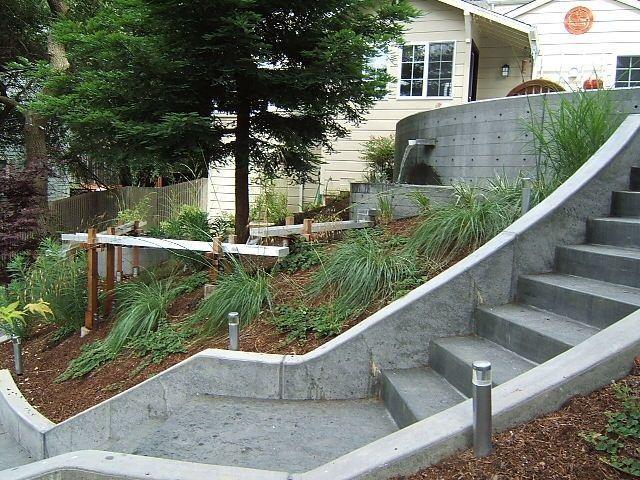
How steep is your slope, and what does that decide?
Measure it first. Slope is rise over run, written as a ratio or a percentage, so a hill that climbs 1 foot for every 3 feet of ground is about 33%. That single number tells you which tools are realistic.
Iowa State University Extension’s guide to gardening slopes and hillsides groups grades this way, and Native Seed Group’s slope erosion guide puts the mulch cutoff at 33%.
| Slope grade | What the sources say | What it points to |
|---|---|---|
| Under 33% | Mulch can secure the soil | Plants and coarse mulch |
| 8% to 16% | Moderately steep; water runs off and gardening gets harder | Contour planting, mulch |
| 20% or more | Steep; needs special planting methods | Erosion blankets, staggered plantings |
| About 30% or more | Too steep to mow | Shrubs and groundcovers instead of lawn |
| About 50% | Often the steepest slope that can support plant growth | Terraces or engineered walls |
The last column is our reading of those thresholds, not a rule from either page. Soil matters too: sandy soil washes away more readily than clay, and thin topsoil over rock needs several seasons of support before plants take hold.
Planting for hillside erosion control landscaping
Plants stop erosion in two ways. Their canopies soften the rain before it hits the ground, and their roots hold the soil together underneath. Trees and shrubs root deepest, so they do the most work, while groundcovers and grasses protect the surface between them.
Layering all of these shields the soil better than any single plant type. That’s the idea behind good hillside erosion control landscaping: no bare patch is left for rain to hit directly.
How you plant matters as much as what you plant. Run rows across the slope along its contour lines, and stagger them, so water can’t find a straight channel downhill. Set each root ball level with the upper slope and mound soil on the lower side, and never bury the trunk flare of a tree or the crown of a perennial.
Iowa State’s list of slope-friendly plants includes juniper, yarrow, stonecrop and creeping thyme. That list comes from a Midwest university, so before you buy, confirm a plant suits Bay Area fog, wind and dry summers. Our Daly City landscaping ideas cover what holds up in this climate.
Mulch that stays put
Not all mulch is equal on a hill. Shredded bark, leaf mold and grass clippings resist washing downhill better than bark chips or river rock, according to Iowa State, because their angular, matted pieces knit together. Apply a thick layer, and keep it away from trunks.
Blankets and netting for steeper ground
Once a slope passes the mulch limit, an erosion control blanket holds the soil while roots form. Native Seed Group describes synthetic geotextiles and organic netting such as coconut-based material. Organic blankets break down on their own, add nutrients as they go and let seeds root through them.
Install a blanket right after planting and pin it down tightly with staples. A loose edge gives water a way underneath.
Terracing a slope into level steps
In hillside erosion control landscaping, terracing breaks one long run of fast water into several short ones. Each flat bench slows runoff and gives plants a level place to root, which is why it’s the usual answer once a hill is too steep for mulch to hold.
Planting terraces should be two to three times wider than the root ball of what goes in them, according to Iowa State. Small stones or bricks along the lower edge keep soil from washing over the plant crown.
For structural terraces, Snohomish County in Washington advises that the bench width be at least equal to the height of the wall below it. Taller steps need more room, so a steep lot gets fewer, wider terraces rather than many narrow ones.
A terrace that’s poorly built can shift the problem instead of solving it. Our landscaping team plans benches and planting together, so the layout we draw is one the plants can actually grow in.
When a retaining wall is the right call
Retaining walls earn their place in hillside erosion control landscaping when the grade is too steep for planted terraces to stay put, or when you need level ground against a house or patio. It holds soil back mechanically, so it isn’t a substitute for plants on the slope above and below.
Height decides how serious the job is. Snohomish County’s retaining wall and terracing guidance requires a building permit and engineered plans for any wall over 4 feet total height, counting the buried portion. A wall that carries extra weight behind it, such as fill or vehicles, needs a permit even when it’s shorter.
Those thresholds belong to that county. Bay Area cities set their own, so check with your building department before you dig.
Small modular blocks from a home center have limited use, per the same page. The wall must stay under 4 feet and carry no extra load, and it needs adequate drainage. Wood isn’t recommended, since treated lumber can leach into the soil and untreated wood decays against it.
Walls need a foundation too. The county describes a 6-inch layer of level, compacted crushed rock, with the top of that base often buried at least 12 inches. Look the wall over at least once a year, and call a geotechnical engineer if you see outward buckling, sagging or cracks in the ground above it.
For paver and block walls, our hardscape services cover the structure and the base beneath it.
Drainage in hillside erosion control landscaping
Most slope failures start with water, so drainage deserves the same planning as the wall or the plants. The goal is to keep water from collecting at the top of the hill or building up behind anything you build.
Start above the slope. Divert runoff from driveways and downspouts before it reaches the hill, using a trench along the top, drain tile or surface drains, as Iowa State suggests. Wattles, which are straw-filled tubes in netting, slow and redirect water at the top, middle or bottom of a slope, especially where the grade changes.
Behind a wall, water pressure is what causes failure. Snohomish County calls a drainage system a required part of the design. It specifies washed drain rock at least 1 foot wide behind the wall and a perforated pipe at least 4 inches across in the lowest layer, sloped slightly toward an outlet. Non-woven fabric over the soil keeps fine particles from clogging the rock.
A quick test tells you how your soil drains. Fill a dug hole with water. If it’s still standing after two or more days, Native Seed Group says rock may sit just below the surface, which means more runoff and more erosion.
Getting plants through the first season
Hillside erosion control landscaping is won or lost in the first months, before roots spread. Protect the soil with a blanket or mulch and water gently so the irrigation doesn’t cause the erosion you’re trying to stop.
Drip irrigation and soaker hoses work best on a hill. A small basin on the downhill side of each root ball holds the water long enough to soak in. On seeded areas, use a mist or low-flow sprinkler and stop the moment water runs down the surface.
Annual ryegrass can serve as a temporary cover crop, but it won’t survive winter, so don’t count on it as the long-term fix. Hydroseeding is best left to a professional. And if the existing slope is turf, Iowa State suggests killing it first and planting through the dead vegetation after a few weeks, which leaves its roots in place to hold soil.
We build follow-up into our work: we return after 30 days to make sure everything is thriving and operating smoothly. On a slope, that visit is when a washed-out corner or a clogged drain outlet gets caught early.
Frequently asked questions
Can grass stop erosion on a steep slope?
Only up to a point. Iowa State notes that slopes of about 30% or more are too steep to mow, so shrubs and groundcovers are the better choice. Sod on grades over 10% needs stakes or staples to stay in place.
How steep is too steep to plant?
Iowa State describes about 50% as often the steepest slope that can support plant growth. Past that, plan on terraces or engineered walls.
Do I need a permit for a retaining wall?
Often, yes. In Snohomish County, Washington, any wall over 4 feet total height, or a shorter one carrying extra load, needs a permit and engineered plans. Your city may set a different line, so ask your building department first.
What kind of mulch works best on a hill?
Shredded bark, leaf mold and grass clippings resist washing downhill better than bark chips or river rock, according to Iowa State. Native Seed Group says mulch alone can secure slopes under a 33% incline.
Do I need a professional for hillside erosion control landscaping?
For anything with walls or heavy drainage work, yes. Native Seed Group says that after you assess your slope, you may need a landscaper or construction specialist, and Snohomish County recommends a licensed engineer or landscape architect before designing a wall.
Sources
- Gardening on Slopes and Hillsides — Iowa State University Extension
- Retaining Walls & Terracing — Snohomish County
- How to Stop Erosion on a Slope or Hill — Native Seed Group